Welcome to the course:
INFIDELITY RECOVERY
Your marriage survived the worst moment most couples never face. Now it deserves the structured, honest, biblical framework that turns survival into restoration.
-
Nine modules covering betrayal, crisis management, forgiveness, transparency, rebuilding intimacy, and the new marriage waiting on the other side.
-
Grounded in Scripture, attachment research, and trauma psychology — built for the couple who chose to stay and do the work.
If your marriage made it through the fire, this course will help you build something stronger from the ashes. Let's go
HOW TO TAKE THIS COURSE: 1. Complete the Pre-Course Assessment before beginning Module 1. 2. Work through each module in order — do not skip ahead. 3. Complete the tool for each module before moving to the next. 4. Each partner completes private sections independently — share only what is indicated. 5. Work with a professional counselor alongside this course wherever possible. 6. Complete the Post-Course Assessment after finishing Module 9. This course is designed to be taken slowly and honestly — not quickly and conveniently. For ongoing support and additional resources. Visit MrMarriage.com
HOW TO TAKE THIS COURSE (PDF) Short Printable Format This course is designed to be taken slowly and honestly — not quickly and conveniently.

Expectation

A leading cause of divorce
Everybody enters marriage with expectations. These expectations are hidden rules that form our reality of how a marriage should function. These expectations are usually unconscious (hidden) rules that we expect our partner to comply with.
Expectation
A leading cause of divorce
Everybody enters marriage with expectations. These expectations are hidden rules that form our reality of how a marriage should function. These expectations are usually unconscious (hidden) rules that we expect our partner to comply with.
Meet the author
.png)
Lloyd Allen is a Marriage educator, Therapist and Coach. He is also a Theologian, Author, and Speaker, and the Founder and CEO of Fixing Marriages Academy, Inc. Trained as a Marriage and Family Therapist at Barry University, with honors, Lloyd brings 30 years of experience helping couples around the world repair, restore, and rebuild their marriages. Happily married and the father of two, Lloyd's greatest passion is helping you build a happy, loving marriage that lasts.
TABLE OF CONTENTS
Build something stronger from the ashes.
DO THIS FIRST:
PRE-COURSE ASSESSMENT.
PRE-COURSE ASSESSMENT.
This helps you to measure your progress
The Pre-Assessment establishes your starting point. Before the course changes you, it captures where you are right now — honestly. That baseline makes your growth visible, measurable, and undeniable when you complete the post-assessment at the end.
Module 1 — Understanding What Happened: The anatomy of betrayal — what infidelity actually is, why it happens, and what it destroys. Defining the wound before attempting the healing.
Module 1 — Understanding What Happened The Anatomy of Betrayal THE FOUNDATION You found out. And nothing has been the same since. Before you can fix anything, you need to understand what actually broke — because what broke is bigger than the act itself. This module gives you honest answers to the questions you are afraid to ask, so you can stop guessing and start healing with something solid beneath your feet. KEY CONCEPTS • The affair was not about you. Betrayal is never the fault of the betrayed spouse. It was a choice made by one person, driven by their own unresolved wounds, weaknesses, or disconnection — not by your failure as a partner. • What was broken was trust — and trust can be rebuilt. It will not happen quickly, and it will not happen automatically. But it has happened for thousands of couples who refused to quit, and it can happen for you. • What you are feeling right now is normal. The shock, the rage, the numbness, the obsessive thoughts — these are not signs that you are falling apart. They are signs that something that mattered deeply to you has been wounded. You are not crazy. You are human. • Both of you are in pain — just differently. One of you is drowning in betrayal. The other is drowning in shame. Understanding this does not excuse what happened — but it is essential for knowing how to move forward together. • Healing begins with honesty, not with forgetting. The goal of this course is not to pretend it never happened. It is to build something so strong on the other side of this that the betrayal no longer defines your marriage. BIOLOGICAL & PSYCHOLOGICAL Your brain is in survival mode right now. The trauma of betrayal triggers the same neurological response as a physical threat — hypervigilance, intrusive thoughts, emotional flooding. This is not weakness. This is biology. Knowing this helps both spouses stop fighting each other's reactions and start understanding them. THEOLOGICAL Hosea did not walk away from a broken marriage — God called him back to it. The same God who said "I will restore to you the years the locust has eaten" (Joel 2:25) is fully capable of restoring what betrayal has consumed. Your marriage is not beyond His reach.
Module 3 — The Betrayed Spouse: Processing trauma, grief, and triggers. Understanding the psychological impact of betrayal and why the pain doesn't follow a straight line.
Module 3 — The Betrayed Spouse Healing Without Losing Yourself THE FOUNDATION This module is for the one who was wounded. Not the one who caused it — the one who is living with it. What you are carrying right now is one of the heaviest things a human being can carry inside a marriage. This module does not minimize that. It gives you a roadmap for healing that does not require you to pretend, perform, or rush — and that does not cost you yourself in the process. KEY CONCEPTS • Your pain has a right to exist. You do not need to manage it for anyone else's comfort. You do not need to grieve on a timeline that works for your spouse. What happened to you was real, it was wrong, and your response to it — whatever it looks like — is valid. • Healing is not the same as forgiveness — and neither is reconciliation. You can begin healing before you are ready to forgive. You can forgive without reconciling. And you can reconcile without forgetting. These are separate processes that move at their own pace and cannot be forced. • You are allowed to ask questions — and you deserve honest answers. The details of what happened belong to you. You have a right to know what you are actually forgiving and what you are actually rebuilding. Your spouse does not get to manage what you are allowed to know. • Obsessive thoughts are a symptom, not a character flaw. The intrusive thoughts, the replaying, the need to check — these are trauma responses. They do not mean you are weak, unstable, or incapable of healing. They mean your brain is trying to make sense of something that does not make sense. • You cannot heal in isolation. Professional support, trusted community, and honest conversation are not signs of weakness. They are the oxygen that healing requires. Do not try to carry this alone to protect anyone's reputation — including your own. BIOLOGICAL & PSYCHOLOGICAL Betrayal trauma shares significant neurological overlap with post-traumatic stress disorder. The intrusive thoughts, hypervigilance, emotional dysregulation, and avoidance behaviors that follow discovery are not personal failures — they are predictable trauma responses. Recovery is not a matter of trying harder. It is a matter of proper support, consistent processing, and time measured in months, not days. THEOLOGICAL The woman who lost one coin did not pretend she had not lost it. She lit the lamp, swept the house, and searched until she found it — and then she called her neighbors to rejoice with her. Luke 15 tells us that God does not minimize loss. He acknowledges it, works through it, and celebrates the restoration. You are not required to be fine. You are invited to be found.
Module 4 — The Unfaithful Spouse: Taking full accountability without defensiveness. Understanding the why behind the choice and what genuine remorse looks like versus performed remorse.
Module 4 — The Unfaithful Spouse Taking Full Responsibility Without Falling Apart THE FOUNDATION This module is for the one who caused the wound. Not the one carrying it — the one who created it. What is required of you right now is the hardest thing you may ever be asked to do — not defend, not deflect, not minimize, and not collapse. This module gives you a framework for taking genuine responsibility in a way that actually serves the healing of your spouse and your marriage, rather than simply managing your own guilt. KEY CONCEPTS • Full responsibility means no qualifications. "I was wrong, but..." is not an apology. It is a defense. The moment you introduce the "but" you have shifted the conversation from accountability to self-protection. Your spouse needs to hear that you understand what you did, that you own it completely, and that you are not looking for someone to share the weight of it. • Your guilt is not the priority right now. The impulse to collapse into shame, to make your remorse the center of the conversation, to need your spouse to comfort you in your guilt — these responses, however genuine, redirect attention from the wounded to the one who caused the wound. Manage your shame in therapy. Show up steadier than that for your spouse. • Transparency is not a punishment — it is the price of re-entry. Access to your phone, your accounts, your location, your schedule — these are not violations of your privacy. Privacy was forfeited when the betrayal began. Transparency now is the first language of trustworthiness, and it must be offered freely, not extracted reluctantly. • Consistency over time is the only thing that will rebuild trust. One honest conversation does not rebuild trust. One month of good behavior does not rebuild trust. Trust is rebuilt by the same person, making the same choices, over a sustained period of time — quietly, persistently, without demanding credit for it. • Ending it completely means ending it completely. No final goodbye. No explanation to the other person. No maintained friendship. No soft landing for anyone but your spouse. The affair ends with a clean, permanent, unambiguous break — and your spouse has the right to know that it has. BIOLOGICAL & PSYCHOLOGICAL Shame, when unprocessed, does not produce genuine change — it produces hiding. Research consistently shows that guilt, which focuses on the behavior, is far more productive for behavioral change than shame, which focuses on the self. The unfaithful spouse who is consumed by shame tends to withdraw, minimize, or seek relief rather than remain present for their partner's pain. Individual therapy is not optional at this stage — it is the infrastructure that makes genuine accountability possible. THEOLOGICAL Zacchaeus did not wait to be confronted. When Jesus came to his house, something broke open in him — and his response was immediate, specific, and costly. Luke 19:8 records no negotiation, no explanation, no partial restitution. Just full accountability and radical generosity. That is the posture this moment requires. Not self-flagellation. Not collapse. Not performance. Just the honest, unhesitating, costly ownership of what you did — and the daily choice to become someone your spouse can trust again.
Module 5 — Rebuilding Honesty and Transparency: Creating a new standard of radical openness. Practical tools for restoring truth as the foundation of the relationship.
Module 5 — Rebuilding Honesty and Transparency The Architecture of a New Foundation THE FOUNDATION You cannot build a new marriage on the foundation of the old secrets. Whatever existed before — the hidden conversations, the deleted messages, the half-truths, the omissions — none of it can serve as the ground floor of what comes next. This module gives both of you a practical, honest framework for building the kind of transparency that makes genuine trust not just possible but inevitable over time. KEY CONCEPTS • Transparency is not surveillance — it is architecture. There is a difference between a spouse checking up on their partner out of anxiety and a couple building shared systems of openness by mutual agreement. One is reactive. The other is constructive. The goal is to build the second kind — where openness is a value, not a punishment. • Honesty now means more than it ever did before. Every honest answer, every unprompted disclosure, every moment where the truth is told when a lie would have been easier — these are deposits in a trust account that was emptied. They do not immediately restore the balance, but they are the only currency that will. • The betrayed spouse has the right to ask anything. There is no question that is off limits during recovery. If the betrayed spouse needs to know something to process what happened, that question deserves an honest answer — not a managed one, not a partial one, and not one shaped by what the unfaithful spouse wishes they had asked instead. • Radical transparency has a season — and it evolves. The level of openness required in the first six months of recovery is not the permanent operating system of a healthy marriage. It is an intensive care measure. As trust rebuilds, the intensity of monitoring naturally decreases — but that transition is led by the betrayed spouse, not decided unilaterally. • Secrets kept for kindness are still secrets. Well-intentioned omissions — things not said to protect the betrayed spouse from further pain — erode the very foundation being rebuilt. If there is anything still hidden, this is the moment to bring it fully into the light. Partial disclosure is a delayed detonation. BIOLOGICAL & PSYCHOLOGICAL Research on trust repair consistently identifies transparency as the single most predictive variable in successful recovery after infidelity. Couples where the unfaithful partner maintained full openness — including unprompted disclosure — showed significantly higher rates of genuine trust restoration than those where transparency was partial or reactive. The brain of the betrayed spouse is scanning for threat constantly. Consistent, voluntary openness is the most powerful signal available that the threat has been removed. THEOLOGICAL Ephesians 4:25 does not soften the instruction — "Therefore, putting away lying, let each one of you speak truth with his neighbor, for we are members of one another." The Greek word for putting away here is apotithemi — to strip off completely, as one removes a garment. Honesty in marriage after betrayal is not an upgrade. It is a return to the only foundation on which a covenant can stand. What was built in darkness must now be rebuilt entirely in the light.
Module 6 — Forgiveness — What It Is and What It Isn't: The biblical and psychological framework for forgiveness. Debunking myths, addressing timeline pressure, and separating forgiveness from reconciliation.
Module 6 — Forgiveness The Most Misunderstood Word in Recovery THE FOUNDATION Forgiveness is the most demanded, most misunderstood, and most prematurely invoked word in the entire conversation about infidelity recovery. It is not a feeling. It is not forgetting. It is not a single event that happens on one particular day and resolves everything that came before it. This module gives you an honest, biblically grounded, psychologically sound understanding of what forgiveness actually is — and what it is not — so that when it comes, it is real, and when it is not yet ready, it is not faked. KEY CONCEPTS • Forgiveness is a decision, not a feeling. You will not wake up one morning feeling like forgiving your spouse. Forgiveness is chosen before it is felt — and the feeling, when it comes, is the fruit of the decision, not the prerequisite for it. Waiting until you feel ready is waiting for something that arrives after, not before, the choice. • Forgiveness does not mean what happened was acceptable. It means you are releasing your right to make your spouse pay for it indefinitely. It does not erase the wrong. It does not minimize the wound. It does not require you to act as though the betrayal never occurred. It means you are choosing not to be permanently defined by it. • Forgiveness is for you — not for the one who hurt you. Unforgiveness is not a punishment your spouse serves. It is a weight you carry. The bitterness, the obsession, the rehearsed grievance — these do not wound the offender. They wound the one holding them. Forgiveness is an act of self-liberation, not of excusing another. • Forgiveness does not require reconciliation. You can fully forgive someone and still choose not to remain in the marriage. These are separate decisions. Forgiveness releases the debt. Reconciliation rebuilds the relationship. One can happen without the other, and neither should be forced. • Premature forgiveness can be a form of avoidance. Rushing to say "I forgive you" before the wound has been honestly named, the grief fully felt, and the accountability genuinely rendered can be a way of avoiding the painful work that real healing requires. True forgiveness is deep. It takes time to get there. BIOLOGICAL & PSYCHOLOGICAL Research in positive psychology and trauma recovery consistently demonstrates that forgiveness — defined not as condoning but as releasing resentment — produces measurable improvements in physical health, emotional regulation, and relational satisfaction. Studies by Dr. Fred Luskin at Stanford University identify forgiveness as one of the most powerful tools available for reducing stress, lowering cortisol, and restoring a sense of personal agency after significant relational harm. Forgiveness does not benefit the offender first. It benefits the one who extends it. THEOLOGICAL Colossians 3:13 does not say forgive when you feel like it. It says "forgive as the Lord forgave you." The Greek word here is charizomai — to give freely, as an act of grace, without requiring the other person to earn it first. That is the standard. It is not a low one. But it is also not an impossible one — because the same grace that is being asked of you was first extended to you. You are not being asked to do something God has not already done on your behalf.
Module 7 — Rebuilding Intimacy: Restoring emotional safety before physical reconnection. The sequential process of moving from guarded to vulnerable again.
Module 7 — Rebuilding Intimacy Coming Back to Each Other After the Breach THE FOUNDATION Intimacy after betrayal does not return on its own. It does not resume because enough time has passed, because the forgiveness conversation happened, or because both of you want it to. It returns because two people make deliberate, repeated, vulnerable choices to move toward each other in the presence of real risk. This module gives you a framework for rebuilding every dimension of intimacy — emotional, physical, spiritual — without rushing past the work that makes it real. KEY CONCEPTS • Emotional intimacy must be rebuilt before physical intimacy is restored. The body follows the heart. Attempting to restore physical connection before emotional safety has been genuinely reestablished does not accelerate healing — it complicates it. The betrayed spouse cannot be physically present with someone they do not yet feel emotionally safe with, and that is not dysfunction. That is wisdom. • Vulnerability is now asymmetrical — and that must be acknowledged. The betrayed spouse is being asked to open up to the very person who caused the deepest wound. That asymmetry is real and must not be minimized or rushed. The unfaithful partner must earn the privilege of the other's vulnerability — not demand it, not expect it on a schedule, and not withdraw when it comes slowly. • Small moments matter more than grand gestures. Rebuilding intimacy happens in the accumulation of ordinary moments — a genuine conversation, an honest answer, a kept promise, a moment of kindness not motivated by guilt. Grand gestures can be meaningful, but they cannot substitute for the daily, quiet, consistent evidence that the person in front of you has changed. • Physical intimacy will likely be complicated for both of you. For the betrayed spouse, the body carries memory. Physical closeness may trigger grief, anger, or dissociation. For the unfaithful spouse, guilt can impair presence. Both responses are normal, both deserve to be named, and neither should be silently endured. This conversation belongs in a counselor's office and in honest dialogue between partners. • Rebuilding intimacy requires building something new — not restoring what was. The marriage that existed before the betrayal is gone. What is being built now is different — and if the work is done honestly, it can be deeper, more honest, and more resilient than what existed before. Trying to return to the old normal is the wrong goal. Building a new and better one is the right one. BIOLOGICAL & PSYCHOLOGICAL Oxytocin — the neurochemical most associated with bonding, trust, and physical closeness — is suppressed by unresolved threat and trauma. This is why emotional safety must precede physical reconnection. The nervous system of the betrayed spouse is still in a state of threat detection. Physical intimacy attempted before that threat response is resolved is neurologically counterproductive. Patience with the timeline of physical reconnection is not rejection — it is biology. Understanding this protects both partners from misreading each other's responses. THEOLOGICAL Song of Solomon does not begin with the wedding night. It begins with desire, with pursuit, with the slow and deliberate movement of two people toward each other. The whole of Scripture treats physical intimacy as the overflow of covenant — not the foundation of it. First Corinthians 13 defines love not as a feeling but as a sustained practice of patience, kindness, and endurance. That is the love that rebuilds what betrayal dismantled — slowly, honestly, and without shortcuts.
Module 8 — The New Marriage: You cannot go back — you must build forward. Establishing new agreements, new boundaries, and a new shared vision for a marriage that is stronger than the one that was broken.
Module 8 — The New Marriage Building Something Stronger Than What Was Lost THE FOUNDATION You have done the hardest work most couples never attempt. You stayed when leaving would have been easier. You told the truth when hiding it would have been simpler. You chose healing when destruction was available. This module is not about putting the old marriage back together. That marriage is gone. This module is about building the new one — and understanding why what comes next, if you build it right, can be stronger, more honest, and more intimate than anything that existed before. KEY CONCEPTS • Post-traumatic growth is real — and it is available to you. Research documents a well-established phenomenon in which individuals and couples who survive significant relational trauma emerge with deeper self-awareness, stronger communication, greater empathy, and more intentional commitment than they possessed before the crisis. This is not guaranteed — but it is genuinely possible, and it is what this final module points toward. • The betrayal does not get to be the defining chapter. It happened. It was real. It caused genuine damage. And it is now part of your story — but it does not have to be the loudest part. Couples who rebuild successfully make a conscious, ongoing choice to define their marriage by what they built after, not by what broke before. • The new marriage requires new agreements. The patterns, boundaries, communication habits, and relational structures that existed before the betrayal were insufficient — not necessarily as causes of the affair, but as protections against it. The new marriage needs explicit agreements about transparency, about connection, about what both partners need and how both partners will show up. These are not restrictions. They are architecture. • Maintenance is now a non-negotiable. Couples who recover from infidelity and then return to the same patterns of disconnection, avoidance, and neglect that preceded it are vulnerable to the same outcome. Regular check-ins, ongoing counseling as needed, honest conversation about needs and drift — these are not signs of an unhealthy marriage. They are the practices of a marriage that intends to stay healthy. • Your story can become someone else's lifeline. The marriage that survived what yours survived — and rebuilt honestly — carries a testimony that no intact marriage can offer. You do not have to broadcast your pain. But the couple you sit across from one day, who believes their marriage cannot survive, may need to know that yours did. BIOLOGICAL & PSYCHOLOGICAL The concept of post-traumatic growth, developed by psychologists Richard Tedeschi and Lawrence Calhoun, identifies five domains of growth that can emerge from significant personal crisis — personal strength, new possibilities, relating to others, appreciation of life, and spiritual change. Couples who engage in structured recovery after infidelity report gains in several of these domains, particularly in communication depth, emotional intimacy, and intentionality of commitment. The research does not romanticize the pain. It documents the possibility of genuine transformation on the other side of it. THEOLOGICAL Revelation 21:5 does not say God will explain the old things. It says He will make all things new. The word in Greek is kainos — not a repaired version of the old, but something qualitatively different, fresh, and better. That is the promise available to a marriage that has walked through betrayal and chosen to stay. Not a patched version of what was. Not a tolerable compromise. Something new. Something that carries the marks of what it survived and is stronger for them. That is what you are building. Build it well.
9 — When One or Both Want to Leave:
— navigating the decision to stay or go after infidelity, with honesty, clarity, and dignity.
It covers uncertainty vs. failure, staying for the wrong reasons, leaving with integrity, and the role of counseling before the final decision.
Module 9 — When One or Both Want to Leave Navigating the Decision with Honesty and Dignity THE FOUNDATION Not every marriage that walks through betrayal will survive it — and this module is for the couples who are not sure yet, as well as the ones who already know. There is no failure in honest uncertainty. There is no shame in acknowledging that the damage may be beyond what either person has the capacity to repair. This module does not tell you what to decide. It gives you a framework for making the most important decision of your life with honesty, clarity, and the kind of dignity that you will not regret on either side of it. KEY CONCEPTS • Uncertainty is not the same as failure. Not knowing whether you want to stay is not a sign that the marriage is already over. It is a sign that you are being honest about where you are. Pressure to decide before you are ready — from your spouse, from family, from your own guilt or impatience — is not wisdom. It is urgency masquerading as clarity. • Staying for the wrong reasons does not serve anyone. Staying because of children, finances, fear, or social pressure without genuine willingness to do the work of recovery is not preservation — it is postponement. A marriage held together by obligation rather than genuine commitment will eventually collapse under the weight of what was never honestly addressed. • Leaving does not mean giving up on God or on yourself. There are situations where the betrayal was not a single event but a pattern — where safety, honesty, and genuine accountability are absent, where the unfaithful partner has shown no evidence of real change, or where the damage to the betrayed spouse's mental and emotional health makes continued presence harmful. In those situations, leaving is not a failure of faith. It is an act of self-preservation that God does not condemn. • If you are leaving, leave with integrity. How this ends matters — for your children, for your own healing, for your future. Rage, revenge, and public destruction do not resolve the pain. They extend it. Whatever your spouse did, the way you choose to exit this marriage will say more about your character than their betrayal said about theirs. • Counseling before the final decision is not optional. A decision of this magnitude — one that will reshape every dimension of your life and the lives of your children — deserves the clarity that comes from professional support, not just the heat of the worst season. Whatever you decide, decide it from a place of as much clarity as you can access. BIOLOGICAL & PSYCHOLOGICAL Decision-making under acute emotional distress is neurologically compromised. The prefrontal cortex — responsible for long-term planning, consequence evaluation, and regulated judgment — is significantly impaired when the limbic system is in a state of sustained activation. This is the physiological reality of crisis decision-making. It is not a character flaw. It is a reason to slow down, seek support, and resist making permanent choices from a temporary state. Give your brain time to access its full capacity before you make a decision this irreversible. THEOLOGICAL Malachi 2:16 has been used to end conversations rather than open them. But the full counsel of Scripture on marriage acknowledges the weight of covenant without weaponizing it against the wounded. Matthew 19 acknowledges that hearts can become hard. First Corinthians 7 acknowledges that sometimes a believing spouse cannot compel the other to remain. God is not honored by a marriage maintained through coercion, performance, or silent suffering. He is honored by honesty, by genuine effort, and by the kind of integrity that chooses well — whatever that choosing leads to.

E-Book:
Infidelity Revocery
-
Infidelity Recovery — A Marriage Course
-
Your marriage survived the worst moment. Now build something stronger. Nine modules of honest, biblically grounded, research-backed recovery — covering betrayal, transparency, forgiveness, intimacy, and the new marriage waiting on the other side. See the E-book.
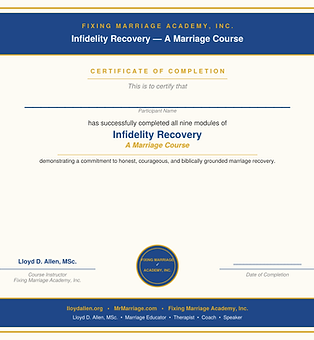
CONGRATULATIONS
Certificate Of Completion
Completing this course required more than time. It required honesty, courage, and the willingness to face what most couples never confront. This certificate marks something significant — not just a course finished, but a marriage chosen, again, at great personal cost.
That is worth recognizing.

Explore My Other Courses:
Your marriage deserves to thrive. Our comprehensive courses—for example, Communication, Sexuality, Conflict Resolution, In-Laws, Expectations, Intimacy, His Needs, Her Needs—equip you with practical principles and proven techniques to transform every aspect of your relationship.
Start your journey toward the thriving marriage you deserve. Visit MrMarriage.com today
Additional Resources
Why you need knowledge. Watch the video here:
Your marriage is worth fighting for — but you can't fight alone.
Join the other Marriage Builders at MarriagesSaved.com, getting real tools, biblical truth, and expert guidance from Lloyd Allen. Communication. Money. Intimacy. Conflict. In-Laws. Everything your marriage needs — in one community built to save it.
Join now. Your marriage can't wait.